 Ze Frank develops interactive web toys. Loads of them are published on his main website www.zefrank.com. First of all most of them are funny, hilarious and also makes you think about what really amuses us or keeps us sane. He pushes the borders of sanity with his atheist, buddhist and christian game. Not rude in any way, in my view and well made. One of my favourites is ''Meditation - flowers", which responses to your own voice. A very relaxing experience that allows you to make any sound you want and see it turn it into a majectic flower. Have a go, you will be amazed.
Saturday, 27 March 2010
Ze Frank
Ze Frank develops interactive web toys. Loads of them are published on his main website www.zefrank.com. First of all most of them are funny, hilarious and also makes you think about what really amuses us or keeps us sane. He pushes the borders of sanity with his atheist, buddhist and christian game. Not rude in any way, in my view and well made. One of my favourites is ''Meditation - flowers", which responses to your own voice. A very relaxing experience that allows you to make any sound you want and see it turn it into a majectic flower. Have a go, you will be amazed.


Tuesday, 16 March 2010
Farmville as an example for learning environments
 Farmville is addictive and a fast way to develop RSI in a matter of weeks. So far the bad news. Zynga cashed 60 million $ from its users. No one I speak to ever spent a buck, so......some of us do in a major way. The good news is that I think we can learn a lot from the people that developed FV. We might consider to use their model of interaction in the way we organise and stimulate learning and teaching. How do they succeed in keeping us coming back to plow, to seed and to harvest, as a individual farmer and as a neighbour. What happens if we relate these activities to the learning process? Isn't that plowing, seeding and harvesting too? Take a look at the interaction - model I developed lately, maybe it gets you going!
Wednesday, 24 February 2010
Farmville and learning
 3 weeks I am playing FarmVille now! It is fun, interesting and a challenge to stop. One can think of thousands of reasons not to play it! It is also a learning experience. Its a combination of a boardgame, a playfull virtual community and a complex and ongoing mathematical problem. It is also about making money and see things grow. The game-team found a brilliant set of tools to stimulate the players. I think this, relatively cheap way of making games has great and immediate potential for young learners. Why? I was hooked me in the first minute.
Thursday, 4 February 2010
Friday, 20 November 2009
Sunday, 22 March 2009
Currambena Primary School
 I first look at the pictures on a school-website. First impression is always dominant in further reasoning. Spinoza considers intuition being the highest order in thinking, above logic. Spinoza's intuition is somewhat different to our present connotation, but still. Currrambena has an appealing philosophy and makes an effort to offer something different in the educational system. What more evidence do you need?
Saturday, 21 March 2009
Village School and Fitzroy Community School
 They started in 1982, so The Village School is well established in Melbourne, Australia. Between 55 and 80 children attend the school each year, guided by 5 permanent teachers, a part-time language teacher, an equestrian instructor (riding horses!!) and various coaches, mentors and parents sharing their specialist skills with the students. On of their principles is learning by making mistakes. They 'encourage children to take risks in a non-threatening, caring environment in order to develop realistic, problem-solving skills.' and also ' that some common sense rules are necessary to ensure physical and emotional safety.' Read it all in their philosophy - document on line. Must be in the air down under!! In the same city another alternative school, Fitzroy Community School. Some international connections in Asia too.
The Alternative School
 The Alternative School (aka TAS) ' was set up in May 2007 to offer a new and exciting alternative KS4 curriculum (age 14 to 19) for all those young people who are not engaging with main stream education.' It is not clear what status this initiative has or how many young people participate. They all strive to get a Duke of Edingburgh Award, which also gives them discounts on outdoor equipment. They ' strive to engage young people in a wide range of positive activities and to develop them as young adults, at a pace that is suited to that young person and with subjects and experiences that means they are interested and therefore willing to partake.' An interesting and innovative approach. Too early to call it a success, however. They maintain a blog that shows a professional video on the project.
Sudbury Valley School

The SVS was founded in 1968 and at the moment there are 39 schools or initiatives on 2 continents that are listed as Sudbury - education schools. They must do something right.
Students are fully responsible for their own learning. In practice this means that students initiate all their own activities and create their own environments. The physical plant, the staff, and the equipment are there for the students to use as the need arises. The Netherlands hosts 2 Sudbury Schools and there are a number of initiatives that are very similar in approach and pedagogy, but find it difficult to survive. The existence of an international community around this initiative and the solid mission statement might explain its success. And the use of villa's like the one pictured of course.
Hole in the wall
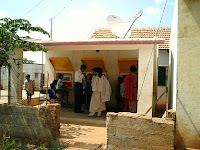 Cut a hole in the wall that separates you from the slums around you. Mount an interactive computerscreen, make some adjustments on the other side for a keyboard and make sure its weather resistent. Then WAIT!! It didn't take long before children, that very likely never touched a computer before found out how it worked and started playing with it, teaching each other. Sugata Mitra did and he didn't stop there. You can read all about it from the website they also made. A beautiful initiative, got me by the ankles, anyway.
Subscribe to:
Posts (Atom)